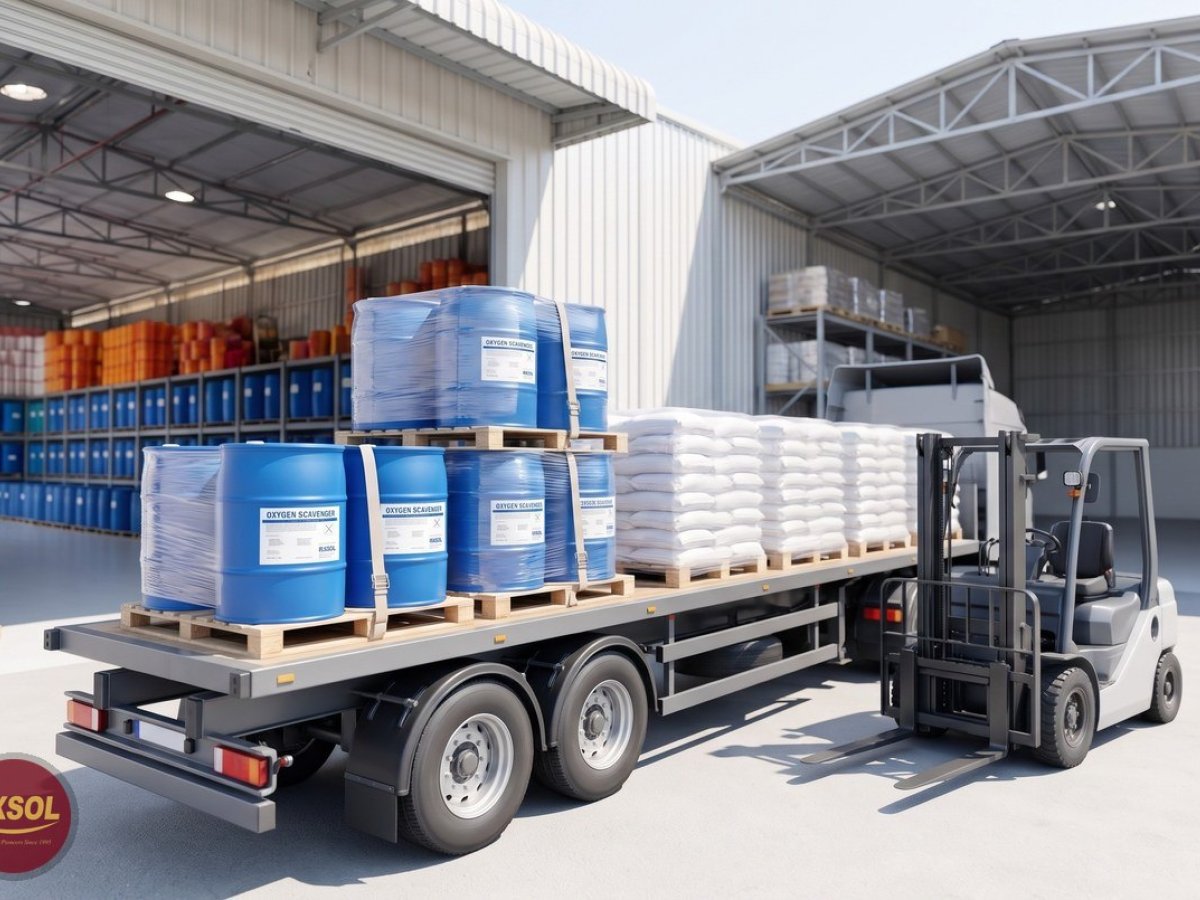
A drilling contractor in Duqm needs rig wash to clean the drill floor and an oxygen scavenger to protect pipe and casing in the mud or brine. As an oilfield chemical supplier in Oman, we supply oxygen scavengers from Barka. Our advice to buyers is to send one list that covers every product you need, including rig wash, oxygen scavenger, corrosion inhibitor and any bulk chemicals. We then confirm what we can supply and quote it for your rig site, with incompatible chemicals kept apart.
What a Duqm Drilling Contractor Orders for the Rig
A rig order seldom arrives as one product. A typical list has a rig wash for the drill floor, decks and surface equipment, an oxygen scavenger for the water-based mud or completion brine, and a filming corrosion inhibitor. It often adds bulk raw chemicals such as caustic soda, acids, solvents or glycols.
Contractors pick the scavenger from our range. The general Oxygen Scavenger comes under part numbers RXSOL-44-6119-025, RXSOL-44-6119-200 and RXSOL-44-6119-250. The Ammonium Bisulfite Oxygen Scavenger (RXSOL-81-6119-220) sits with our drilling fluid and mud chemicals. The Hydro Testing Oxygen Scavenger (RXSOL-20-4035-210) covers hydrotest water.
Each product handles a different part of the same job. Oxygen scavengers are reducing agents. They react with free dissolved oxygen in water, brine or drilling fluid, which stops oxygen-driven corrosion of drill pipe, casing and surface equipment. Bisulfite scavengers are normally used together with a separate filming corrosion inhibitor, so the two belong on the same order. One combined delivery also means one receiving check at the rig gate instead of several.
Choosing an Oxygen Scavenger: Bisulfite, Sulfite or Organic
Sodium bisulfite and ammonium bisulfite are the most common oilfield oxygen scavengers. Ammonium bisulfite dissolves more readily in water and usually reacts faster, but the ammonium can promote bacterial growth. Other chemistries include sulfites, hydrazine and erythorbate.
Choose by fluid type. For fresh water muds and monovalent brines, a sulfite-based oxygen scavenger is the usual choice. Sulfite and bisulfite scavengers are sensitive to calcium and magnesium. Typical hardness limits are about 300 mg/L for brine grades and up to about 2,000 mg/L for drilling-fluid grades. Calcium brines and seawater need organic, sulfur-free scavengers. Organic grades are also preferred in drill-in and completion brines, because sulfate from inorganic scavengers can precipitate and damage the formation. Erythorbate-type scavengers decompose in brine at about 275°F (135°C) and above, turning clear brine dark brown, so check your bottom-hole temperature before choosing one.
Biocides need checking too. Bisulfite scavengers lose activity when used with glutaraldehyde and other aldehyde-type biocides. Tell us your brine type, hardness and biocide programme when you ask for a quote and we will confirm which grade suits the well.
| Item | Detail |
|---|---|
| Part numbers | RXSOL-44-6119-025, RXSOL-44-6119-200, RXSOL-44-6119-250 (Oxygen Scavenger); RXSOL-81-6119-220 (Ammonium Bisulfite Oxygen Scavenger); RXSOL-20-4035-210 (Hydro Testing Oxygen Scavenger) |
| Application | Water-based drilling fluids, completion and workover brines, seawater injection, hydrotesting water and acid stimulation fluids (typical for this product class) |
| Typical dosage | Continuous injection at the pump suction, starting at 1 to 2.5 gal/h (3.8 to 9.5 L/h); clear monovalent brines about 1 gal per 100 bbl (0.24 kg/m³, about 0.025% by volume); adjust from flowline sulfite tests |
| Typical properties | Light green to yellow liquid with a strong sulfur dioxide odour; specific gravity about 1.24 to 1.39 (roughly 10.6 to 10.8 lb/gal); pH about 4.9 to 5.5; soluble in fresh water and brine; ammonium bisulfite liquids are typically about 50 to 55% up to 65% |
| Packing | Typical for this product class: 5-gal (18.9 L) cans and 55-gal (208 L) plastic drums. We confirm the pack size for each part number in the quote |
| Storage | Dry, well-ventilated area, containers closed, away from heat, sparks, flames and incompatible materials |
Typical Dosage and Excess Sulfite Targets on the Rig
Dose liquid scavengers continuously at the pump suction with a metering pump, never through the mixing hopper. A typical starting rate is 1 to 2.5 gal/h (3.8 to 9.5 L/h), which you then adjust from flowline sulfite tests. For clear monovalent brines, a typical first treatment is about 1 gal per 100 bbl (0.24 kg/m³, about 0.025% by volume), with more where oxygen is known to be high.
A rule of thumb for planning: about 10 ppm excess sulfite treats out about 1 ppm dissolved oxygen. About 60 ppm of 65 wt% ammonium bisulfite lowers dissolved oxygen in water from about 9 ppm to about 50 ppb. The reaction runs faster at higher temperature, and catalysed grades use transition metals such as cobalt.
Excess sulfite targets vary by product and system. Published figures run from about 20 to 80 ppm (brine to fresh water systems) up to 100 to 300 mg/L at the flowline, with the higher end for hard or polymer-viscosified brines. Check the residual with a sulfite test kit near the bell nipple. Using the hopper less and cutting surface agitation lets in less air, which lowers scavenger demand. Mechanical deaeration alone usually does not get oxygen low enough without a chemical scavenger.
Loading the Truck: Keep Caustic Soda Apart
Rig orders often put scavenger and caustic soda on the same truck, so this is the most important check when loading. Ammonium bisulfite releases ammonia gas above about pH 10. It must never go into a container that holds caustic soda, because the ammonia gas can create an explosion risk.
Keep the scavenger cans and drums separate from caustic soda and acids, and keep other incompatible chemicals apart as well. Your store at the rig should keep the same separation after unloading. Containers stay closed in transit to limit air exposure, because the scavenger reacts with oxygen from the air as well as from the fluid.
Storage, Handling and Documents at the Rig Site
Store the scavenger in a dry, well-ventilated area with the containers closed, away from heat, sparks, flames and incompatible materials. In a Duqm or Nizwa summer, that means a shaded, ventilated store, not open sun on the laydown yard.
Treat it as a reactive industrial chemical. Open and mix it only in well-ventilated areas, avoid breathing the vapours, add it only to water or brine and never mix it neat with other chemicals. Wear PPE and follow the SDS. If your receiving procedure needs an SDS, a certificate of analysis or transport paperwork, put that in your quote request and we will confirm what is available.
Oilfield Chemical Supplier Oman: Where to Buy in Muscat, Duqm and Nizwa
Oman Chem (Muscat & Barka for Business Trading), Barka Industrial Area, Sultanate of Oman. Phone +968 77333599, WhatsApp +968 77333599, email muscatchem@gmail.com.
Give us the rig location in Duqm, Nizwa or the Muscat area, and we will confirm delivery arrangements with the quote. The same Ammonium Bisulfite Oxygen Scavenger is also listed on Sohar Chemical for buyers near Sohar port and on Muscat Chemical for Muscat and Ruwi sites. To build one order, send the full list through our quote request page.
Frequently Asked Questions
Who supplies oilfield and drilling chemicals in Oman?
Oman Chem supplies oxygen scavengers, including ammonium bisulfite grades, from Barka Industrial Area. Send us your product list and rig location, and we will confirm what we can supply and how it can be delivered.
How much oxygen scavenger do I add to drilling mud or brine?
A typical starting rate is 1 to 2.5 gal/h (3.8 to 9.5 L/h) at the pump suction. Clear monovalent brines typically start at about 1 gal per 100 bbl (0.24 kg/m³, about 0.025% by volume). Adjust the rate from flowline sulfite tests.
Can I use a sulfite oxygen scavenger in calcium brines?
No. Sulfite and bisulfite scavengers are sensitive to calcium and magnesium. Calcium brines and seawater need organic, sulfur-free scavengers.
Why must oxygen scavenger never be mixed with caustic soda?
Ammonium bisulfite releases ammonia gas above about pH 10. It must never go into a container that holds caustic soda, because the ammonia gas can create an explosion risk.
Can I order several products in one shipment to Duqm or Nizwa?
Send the full list and rig location and we will confirm what can go on one load and the delivery arrangements with the quote. The scavenger must be kept apart from caustic soda and acids.
Request a quote: send your product list and rig location on WhatsApp +968 77333599.
Frequently asked questions
Who supplies oilfield and drilling chemicals in Oman?
Oman Chem supplies oxygen scavengers, including ammonium bisulfite grades, from Barka Industrial Area. Send us your product list and rig location, and we will confirm what we can supply and how it can be delivered.
How much oxygen scavenger do I add to drilling mud or brine?
A typical starting rate is 1 to 2.5 gal/h (3.8 to 9.5 L/h) at the pump suction. Clear monovalent brines typically start at about 1 gal per 100 bbl (0.24 kg/m³, about 0.025% by volume). Adjust the rate from flowline sulfite tests.
Can I use a sulfite oxygen scavenger in calcium brines?
No. Sulfite and bisulfite scavengers are sensitive to calcium and magnesium. Calcium brines and seawater need organic, sulfur-free scavengers.
Why must oxygen scavenger never be mixed with caustic soda?
Ammonium bisulfite releases ammonia gas above about pH 10. It must never go into a container that holds caustic soda, because the ammonia gas can create an explosion risk.
Can I order several products in one shipment to Duqm or Nizwa?
Send the full list and rig location and we will confirm what can go on one load and the delivery arrangements with the quote. The scavenger must be kept apart from caustic soda and acids.

