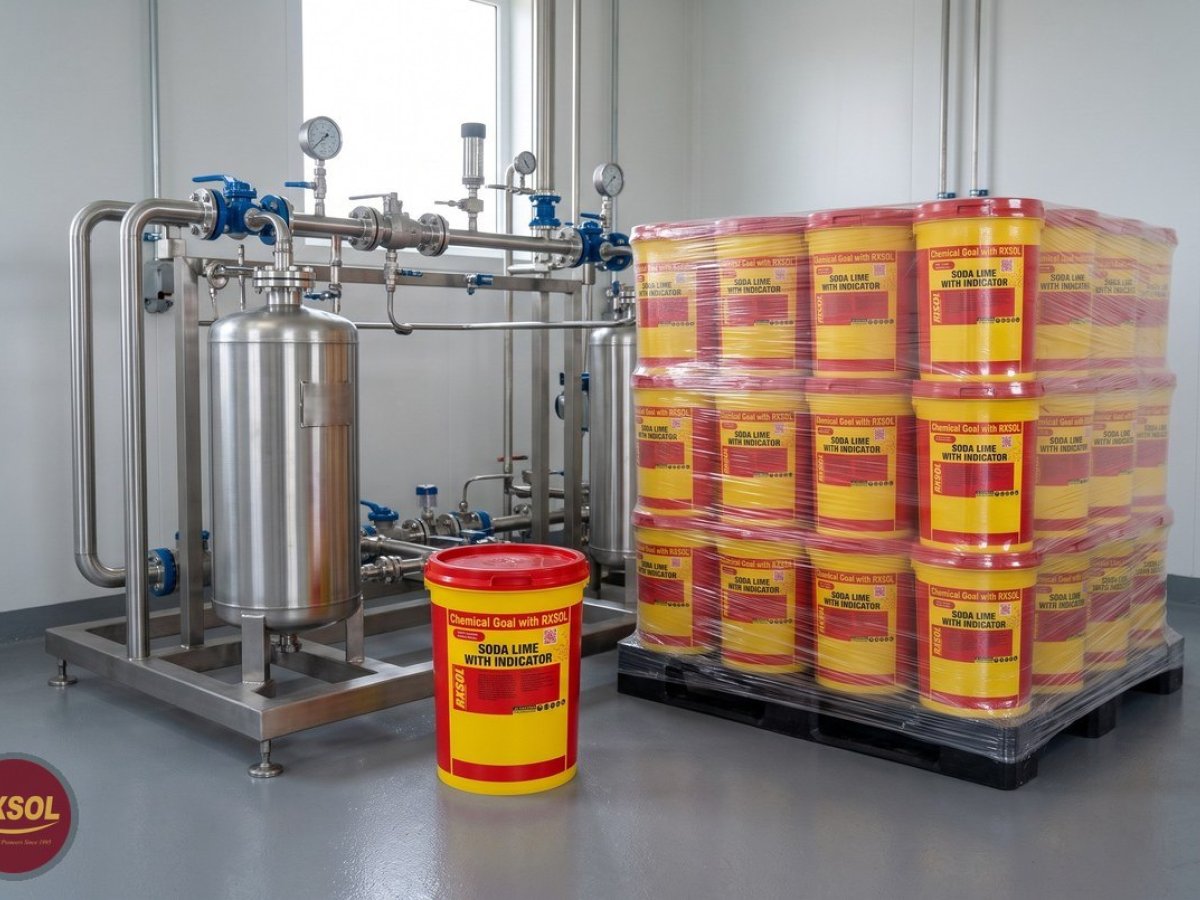
If you need CO2 taken out of breathing gas or a chamber atmosphere, soda lime with indicator is the absorbent to order. We supply soda lime with indicator from Barka Industrial Area in Oman, listed as Soda Lime with Indicator and as an AR grade. It is a granular absorbent made mostly of calcium hydroxide with a small share of sodium hydroxide, and a dye turns the granules from white to violet as the capacity is used up. It is related to caustic soda, but it is a different product and you should order it by name.
What is soda lime with indicator, and is it caustic soda?
Soda lime is a granular mixture of calcium hydroxide with a small share of sodium and/or potassium hydroxide and water. Calcium hydroxide is the main absorbent: it reacts with carbon dioxide and ends up as calcium carbonate. The sodium hydroxide acts as a catalyst in the CO2 absorption reaction, which is where the word soda in the name comes from.
Caustic soda is sodium hydroxide on its own, sold as flakes, pearls or lye. In typical soda lime the hydroxide mix is 96 to 98% calcium hydroxide and only 2 to 4% sodium and/or potassium hydroxide. Caustic soda flakes are far more corrosive, pick up water and cake, and give no colour warning, so they have no place in a scrubber canister.
Composition, grades and typical specification
The finished granules are typically 81 to 87% hydroxide mix and 13 to 19% water. That water is part of the chemistry: overly dried soda lime can produce carbon monoxide when exposed to some volatile agents, so it must not dry out. Typical granule size is 4 to 8 mesh (about 2.5 to 6 mm irregular granules) or uniform spheres of 3 to 4 mm.
Indicating soda lime is made to different grades that differ mainly in purity, test method and the paperwork your client expects. Typical figures for the common grade types are:
- AR or reagent grade for laboratory use. Typical CO2 absorption capacity is ≥19.0% by weight, with loss on drying ≤20% (10 g, 200°C, 2 h). We list it as Soda Lime with Indicator AR, part RXSOL-60-6605-450.
- Technical grade for general CO2 removal from gas streams. Typical loss on drying at 200°C is about 18% and CO2 absorption is at least 20%.
- Medical USP type grade for breathing systems where the equipment maker calls for it: typical CO2 activity ≥19%, water 12 to 19%, total alkali metal ≤4%, calcium hydroxide as the balance, hardness ≥90, and a white to violet indicator.
Our Soda Lime with Indicator, part RXSOL-95-8197-025, sits in our rigs and oilfield range. Check the grade your equipment manual or client specification names against the product listing and the SDS before you order.
| Item | Detail |
|---|---|
| Part numbers | RXSOL-95-8197-025 and RXSOL-95-8197-005 (Soda Lime with Indicator); RXSOL-60-6605-450 (Soda Lime with Indicator AR) |
| Application | CO2 removal from breathing gas, hyperbaric and recompression chambers, rebreathers, refuge chambers and laboratory use |
| Typical composition | Ca(OH)2 >85%, NaOH <3.5%, moisture 12 to 19%, hardness >90% |
| Typical granule size | 2.5 to 6.0 mm off-white irregular granules |
| Typical CO2 capacity | >100 litres of CO2 for each kg; ≥19.0% by weight for reagent grade |
| Indicator | pH-sensitive dye, usually ethyl violet, white to violet as capacity is used |
| CAS number | 8006-28-8 |
| Transport | UN1907, Soda lime, Class 8 (corrosive), Packing Group III |
| Packing | Confirmed on quote. Typical for this product class: 1 kg and 5 kg jars for labs, drums or jerricans for larger systems |
Typical figures describe this class of product. Check the SDS for the exact grade supplied.
Where soda lime is used
Soda lime keeps CO2 in breathable air, gas streams and confined spaces at a safe level, typically below 1%. Typical applications include:
- Helium-oxygen breathing systems and diving rebreathers.
- Hyperbaric and recompression chambers.
- Mines and refuge chambers, where scrubbers hold CO2 down in a closed space.
- Medical anaesthesia circuits, and safety and military breathing systems.
- Submarines and other closed environments.
How the colour indicator works and when to change soda lime
The indicator is a pH-sensitive dye, usually ethyl violet. As the granules turn to carbonate the dye shifts and the granules go from white to violet. Some grades use a white-to-pink indicator, so check which colour your stock shows before you brief the crew.
A common rule is to change the absorbent when about two-thirds of the canister has changed colour. Colour on its own can mislead you in two ways:
- Exhausted absorbent left to stand can revert from violet to white within a few hours. A white canister after a shutdown or an overnight stop is not proof of fresh absorbent.
- Fluorescent lighting or sunlight can degrade the ethyl violet dye, so exhausted soda lime may stay white.
Use a CO2 reading as the main check. Real capacity depends on the CO2 load, for example how hard a diver or chamber occupant is working, so fixed-time change-out estimates can be unreliable. Log the CO2 trend at the scrubber outlet and change the fill when it starts to rise, whatever the colour shows.
Sizing, storage and handling
To plan stock, start from the typical capacity of more than 100 litres of CO2 for each kilogram of granules. On that figure a canister holding 5 kg of granules can in theory take up more than 500 litres of CO2. Divide that figure by your system's design CO2 load for a rough time for each fill, then hold enough for your longest job plus at least one spare fill, because heavy work uses the bed up faster.
Soda lime absorbs CO2 from the air, so its shelf life is poor unless containers stay tightly capped, and a jar left open loses capacity. Keep containers tightly sealed in a dry place, away from direct sunlight and strong UV, above freezing, and away from strong acids. The granules are friable, so avoid rough handling that creates dust when you fill canisters.
Hazards, PPE, UN1907 transport and disposal
Soda lime is caustic and alkaline. SDSs classify soda lime as causing skin irritation and serious eye irritation, and as harmful to aquatic life. Some grades are classified as corrosive (Skin Corr. 1A / Eye Dam. 1, H314). Always check the SDS for the grade supplied. Wear gloves and eye protection when handling.
For transport it is UN1907, Soda lime, Class 8 (corrosive), Packing Group III, under DOT, IATA and IMDG. Plan road moves and offshore shipments as dangerous goods, and keep the SDS with the stock at the point of use.
Spent soda lime is mostly calcium carbonate with some alkali left in it. Treat it as alkaline waste: collect it in a closed, labelled container, keep it out of drains and the sea, and hand it to your site's approved waste route as set out in the SDS and your HSE plan.
Where to buy soda lime with indicator in Oman
Oman Chem (Muscat & Barka for Business Trading) supplies soda lime with indicator from Barka Industrial Area, Sultanate of Oman. Call +968 77333599 or message us on WhatsApp +968 77333599 with the grade, the quantity and the delivery site.
Pack sizes are confirmed on the quote. The same product is also listed on Sohar Chemical and on Muscat Chemical.
Frequently asked questions
Is soda lime the same as caustic soda?
No. Caustic soda is sodium hydroxide on its own. Soda lime is mostly calcium hydroxide, with typically 2 to 4% sodium and/or potassium hydroxide as a catalyst, plus water and a colour indicator.
How do I know when soda lime is exhausted?
The granules turn from white to violet, and a common rule is to change when about two-thirds of the canister has changed colour. Used soda lime can revert to white within a few hours and light can degrade the dye, so a rising CO2 reading is the more reliable sign.
How much CO2 can 1 kg of soda lime absorb?
A typical indicating grade absorbs more than 100 litres of CO2 for each kilogram, and reagent grades are typically specified at ≥19.0% by weight. Real capacity depends on the CO2 load and how well the stock has been stored.
How should soda lime be stored and what is its shelf life?
Keep containers tightly sealed in a dry place, away from direct sunlight, strong UV and strong acids. Soda lime absorbs CO2 from the air, so shelf life is poor once a container is left open.
Request a quote for soda lime with indicator on WhatsApp +968 77333599 or through our quote request page, and tell us the grade, quantity and delivery site.
Frequently asked questions
Is soda lime the same as caustic soda?
No. Caustic soda is sodium hydroxide on its own. Soda lime is mostly calcium hydroxide, with typically 2 to 4% sodium and/or potassium hydroxide as a catalyst, plus water and a colour indicator.
How do I know when soda lime is exhausted?
The granules turn from white to violet, and a common rule is to change when about two-thirds of the canister has changed colour. Used soda lime can revert to white within a few hours and light can degrade the dye, so a rising CO2 reading is the more reliable sign.
How much CO2 can 1 kg of soda lime absorb?
A typical indicating grade absorbs more than 100 litres of CO2 for each kilogram, and reagent grades are typically specified at ≥19.0% by weight. Real capacity depends on the CO2 load and how well the stock has been stored.
How should soda lime be stored and what is its shelf life?
Keep containers tightly sealed in a dry place, away from direct sunlight, strong UV and strong acids. Soda lime absorbs CO2 from the air, so shelf life is poor once a container is left open.

