Dissolved oxygen in injection water corrodes your flowlines, tubing and well completions. An oxygen scavenger such as our Ammonium Bisulfite Oxygen Scavenger (RXSOL-81-6119-220) removes what is left of it after deaeration. Your dose depends on two things: how much dissolved oxygen remains in the water, and the active strength of the product. On a 100% active basis, 1 ppm of oxygen uses about 6.2 ppm of ammonium bisulfite. In the field you add a margin above that figure and then adjust the rate against a measured residual. Oman Chem is based in the Barka Industrial Area, Sultanate of Oman.
Why oxygen has to come out of injection water
Seawater and shallow aquifer water both carry several mg/l of dissolved oxygen at ambient temperature. In carbon steel lines that oxygen causes pitting corrosion. The iron oxide it produces then blocks cartridge filters and plugs the face of the injection well. Oxygen also lets aerobic bacteria grow on pipe walls and in tanks.
Most injection plants take out the bulk of the oxygen mechanically, in a vacuum deaerator or gas stripping tower. A chemical scavenger then removes the last part. Water flood specifications usually set the residual oxygen target in parts per billion. Your operator's water injection specification gives the exact figure your plant has to meet.
Which RXSOL oxygen scavenger fits your water
We list three oxygen scavenger products on Oman Chem. The Ammonium Bisulfite Oxygen Scavenger sits in our drilling fluids and oilfield chemicals range. Our general Oxygen Scavenger is in the corrosion inhibitor range under three part numbers. The Hydro Testing Oxygen Scavenger (RXSOL-20-4035-210) is listed for hydrotest water, which sits in new pipelines and vessels for days or weeks before commissioning.
The table shows what each product record holds today.
| Product | Part number | Range |
|---|---|---|
| Ammonium Bisulfite Oxygen Scavenger | RXSOL-81-6119-220 | Drilling Fluids & Mud Oil Field chemicals |
| Oxygen Scavenger | RXSOL-44-6119-025 | Corrosion Inhibitor |
| Oxygen Scavenger | RXSOL-44-6119-200 | Corrosion Inhibitor |
| Oxygen Scavenger | RXSOL-44-6119-250 | Corrosion Inhibitor |
| Hydro Testing Oxygen Scavenger | RXSOL-20-4035-210 | Tank Cleaner |
If you are not sure which grade suits your water, send us the water source, the flow rate and your current oxygen reading, and we will advise. For a general introduction to scavengers in boilers, closed loops and oilfield water, read our article on what an oxygen scavenger is and where it is used in Oman.
How to work out the oxygen scavenger dose
Start with the chemistry. Bisulfite reacts with dissolved oxygen to form sulfate, and the reaction ratio is fixed. On a 100% active basis, 1 ppm of dissolved oxygen needs about 6.2 ppm of ammonium bisulfite, or about 7.9 ppm of sodium sulfite. Commercial scavengers are sold as solutions, so the product dose is higher than the active figure. To get it, divide the active requirement by the active fraction of the product you use.
Field programmes then dose above the theoretical figure so the reaction is complete before the water reaches the injection pumps. The size of that excess is typical for this product class: it is set during commissioning, not fixed in advance. A simple method:
- Measure dissolved oxygen at the deaerator outlet with an online analyser or a colorimetric test kit.
- Multiply the reading in ppm by the theoretical ratio for the product, then correct for active content.
- Add the commissioning excess agreed with your operator's corrosion engineer.
- Multiply the dose in ppm by the water flow to get the pump rate. For example, 1 ppm by mass in 1,000 m³ of water is 1 kg of product.
- Check residual oxygen and residual sulfite downstream, and adjust the pump rate until both are inside your specification.
Chlorine uses up scavenger before the scavenger can react with oxygen. If your intake is chlorinated against marine growth, either include the residual chlorine in the dose or remove it first. Too much scavenger causes its own problem: the extra sulfate in the injected water can feed sulfate reducing bacteria, which are a known cause of reservoir souring.
Injection point, handling and safety
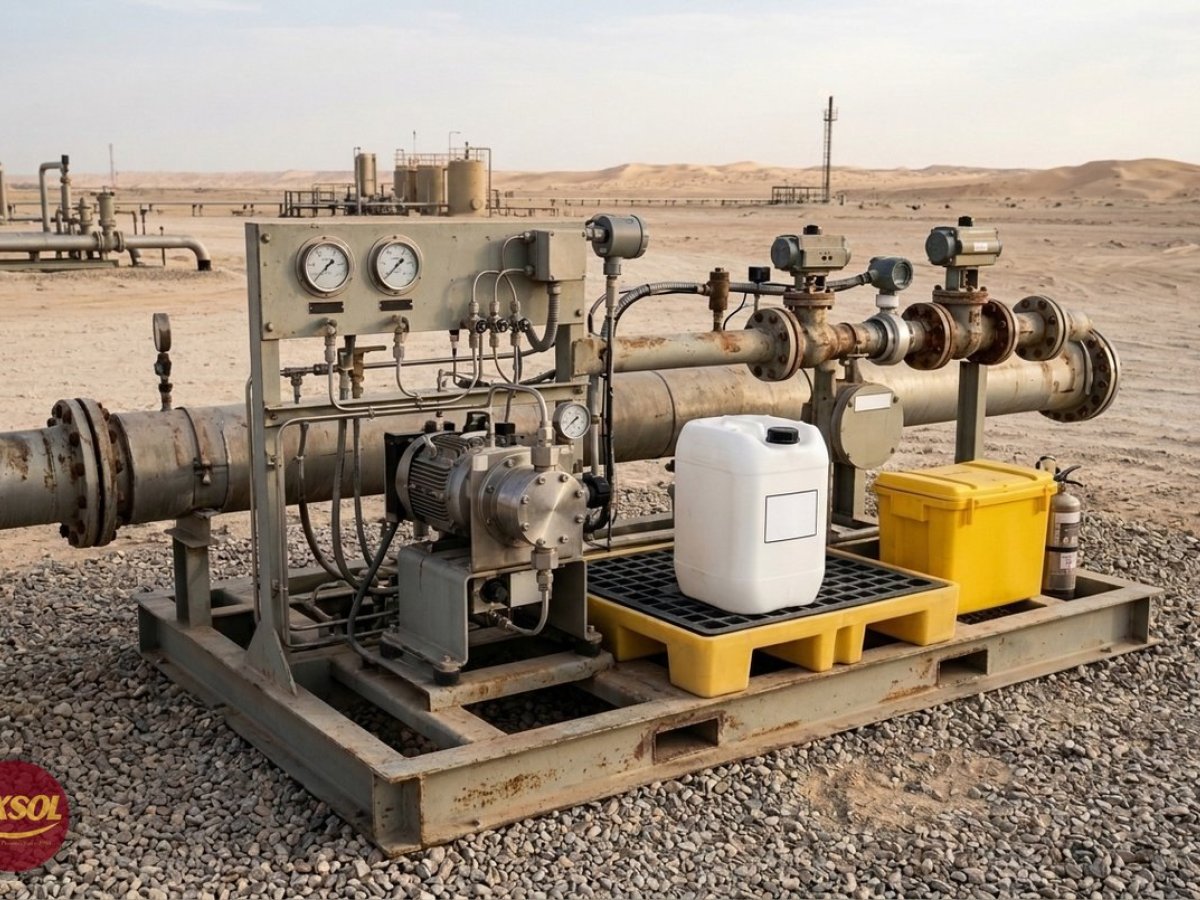
Inject the scavenger as close to the deaerator outlet as practical, usually into the deaerator sump or the suction of the booster pumps. That gives the water the longest contact time before the main injection pumps. Use a dosing pump and an injection quill in stainless steel or a compatible plastic, and keep the chemical feed line short and closed to air. Scavenger left in an open day tank reacts with the air and loses strength before it is dosed.
Bisulfite solutions give off sulfur dioxide gas if they are mixed with acids. Store them away from acids and oxidisers and keep containers closed. Wear chemical goggles and resistant gloves when you decant product or connect containers. Keep an eyewash and a spill kit at the skid, and follow the safety data sheet for the product you use. Keep the biocide injection point separate from the scavenger point, and check that the two chemicals are compatible before you run both programmes on the same line.
Where oilfield contractors use oxygen scavenger in Oman
Water injection for pressure maintenance runs across the oilfields of the Omani interior. Typical uses for this product class include:
- Seawater and aquifer water injection plants, downstream of the deaerator.
- Hydrotesting new flowlines, trunk lines and storage tanks before handover, where the water stays in the line for a long period.
- Pipeline preservation, when a line is left full of water between construction and start-up.
- Completion and packer brines, where oxygen-free fluid protects tubing and casing.
For hydrotest work, order the Hydro Testing grade by its part number so that your method statement and the delivery note match.
Where to buy oxygen scavenger in Muscat and Oman
Oman Chem (Muscat & Barka for Business Trading), Barka Industrial Area, Sultanate of Oman. Phone +968 77333599, WhatsApp +968 77333599, email muscatchem@gmail.com.
Tell us where your site is, and we will discuss the arrangements. If your project is on the Batinah coast, the same ammonium bisulfite grade is also listed on our Sohar Chemical site. When you ask for a quote, give us the part number, the quantity and the delivery location.
Frequently asked questions
How much oxygen scavenger do I need per cubic metre of injection water?
It depends on the dissolved oxygen reading after deaeration and on the active content of the product. On a 100% active basis, ammonium bisulfite needs about 6.2 ppm for each 1 ppm of oxygen, and 1 ppm in 1 m³ of water is 1 g. Send us your oxygen reading and flow rate, and we will help you work out a starting rate.
Can I use oxygen scavenger in chlorinated seawater?
Yes. Chlorine reacts with the scavenger first, so your dose has to cover the residual chlorine as well as the oxygen. Many plants place the scavenger point downstream of the chlorine contact time so that less scavenger is lost to chlorine.
What is the difference between your Oxygen Scavenger and the Ammonium Bisulfite Oxygen Scavenger?
The Ammonium Bisulfite Oxygen Scavenger (RXSOL-81-6119-220) is in our oilfield chemicals range and takes its name from its active chemistry. The Oxygen Scavenger (RXSOL-44-6119-025, RXSOL-44-6119-200 and RXSOL-44-6119-250) is listed in the corrosion inhibitor range. Ask us about the grade that suits your water.
Do you supply an MSDS with the order?
Tell us which grade you need when you request a quote, and we will advise on the documents available so that your HSE team can review them before delivery.
To request a quote, message us on WhatsApp at +968 77333599 or use the Oman Chem quote request form, with the part number, the quantity and your delivery site.
Frequently asked questions
How much oxygen scavenger do I need per cubic metre of injection water?
It depends on the dissolved oxygen reading after deaeration and on the active content of the product. On a 100% active basis, ammonium bisulfite needs about 6.2 ppm for each 1 ppm of oxygen, and 1 ppm in 1 m³ of water is 1 g. Send us your oxygen reading and flow rate, and we will help you work out a starting rate.
Can I use oxygen scavenger in chlorinated seawater?
Yes. Chlorine reacts with the scavenger first, so your dose has to cover the residual chlorine as well as the oxygen. Many plants place the scavenger point downstream of the chlorine contact time so that less scavenger is lost to chlorine.
What is the difference between your Oxygen Scavenger and the Ammonium Bisulfite Oxygen Scavenger?
The Ammonium Bisulfite Oxygen Scavenger (RXSOL-81-6119-220) is in our oilfield chemicals range and takes its name from its active chemistry. The Oxygen Scavenger (RXSOL-44-6119-025, RXSOL-44-6119-200 and RXSOL-44-6119-250) is listed in the corrosion inhibitor range. Ask us about the grade that suits your water.
Do you supply an MSDS with the order?
Tell us which grade you need when you request a quote, and we will advise on the documents available so that your HSE team can review them before delivery.

