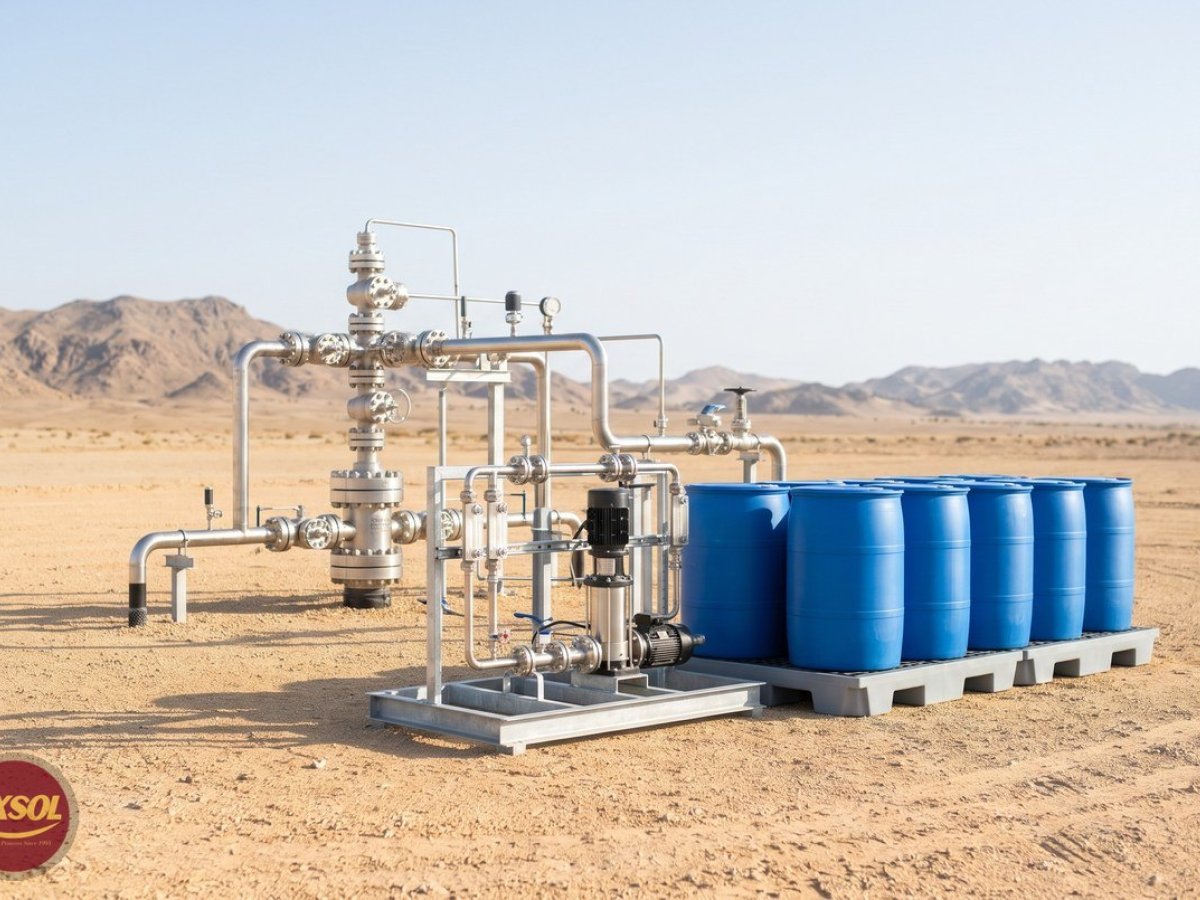
Gas hydrates can block a flowline, choke or instrument line within hours, and ethylene glycol injected at the wellhead is one of the standard ways to stop them on Oman gas wells. For most wellhead and flowline duties the glycol to order is monoethylene glycol (MEG). Your process engineer sets the injection rate from the hydrate curve of your gas and the water rate, and we list ethylene glycol, MEG and triethylene glycol from Barka Industrial Area.
What gas hydrates are and why they form on Oman wells
Gas hydrates are ice-like solids that form when free water and light gas molecules such as methane, ethane and propane meet at high pressure and low temperature. At wellhead pressures they can form well above 0 °C, so a line does not need to be freezing to block. A hydrate plug stops flow, damages chokes and can move along the line when pressure is released, so it is a safety hazard as well as a production loss.
Two conditions catch crews out in Oman. The first is the pressure drop across a choke or control valve: gas cools as it expands (the Joule-Thomson effect), and the downstream side of a choke can run many degrees colder than the flowing temperature. The second is the interior winter. Night temperatures in the desert south of Nizwa fall into single figures between December and February, and exposed flowlines, sample points and instrument tubing cool quickly after sunset. A restart after a shut-in, with a cold line and full pressure, is the classic moment for a plug.
How ethylene glycol prevents hydrates
Ethylene glycol is a thermodynamic hydrate inhibitor. Once it dissolves in the produced water, it lowers the temperature at which hydrates can form at a given pressure, in the same way it lowers the freezing point of engine coolant. The more glycol in the water phase, the larger the shift.
Your engineer works out the glycol concentration needed in the water phase from the hydrate curve of your gas, the lowest expected line temperature and the water production, then turns that into a pump rate in litres per hour. Correlations such as the Hammerschmidt equation give a first estimate, and process simulation gives the design figure. We supply the glycol; the dose belongs to your process design.
On many gas systems glycol has two practical advantages over methanol. It has a much lower vapour pressure, so far less of it is lost into the gas, and it can be recovered from the produced water and reused through a regeneration unit. Methanol is still common for short-term treatment and for clearing plugs, so many sites keep both on hand.
MEG, ethylene glycol or TEG: which to order
Monoethylene glycol and ethylene glycol are the same chemical. MEG is the name used in oil and gas, and ethylene glycol is the name on most chemical lists. For wellhead and flowline hydrate injection and for glycol and water freeze protection, this is the product to order. We list it as Ethylene Glycol, part number RXSOL-19-1182-010, and as Mono Ethylene Glycol, part number RXSOL-19-1210-025. Tell us the end use and your client's specification when you ask for a quote, and we will confirm which grade and pack fits.
Triethylene glycol does a different job. On gas plants it is the usual liquid for dehydration in a contactor tower, where it absorbs water vapour from the gas before export, and it is not normally the glycol you inject at a wellhead for hydrate control. If your plant runs a TEG dehydration unit, our Tri Ethylene Glycol, part number RXSOL-19-1207-025, is the product for make-up supply.
Freeze protection with glycol and water
The same chemistry protects water-filled equipment from freezing: hydrotest water left in lines, chilled water circuits, test rigs and equipment heading to colder sites. Published freezing point tables for ethylene glycol in water give roughly minus 15 °C for a 30% by weight solution and roughly minus 36 °C for 50% by weight. Check the exact figure for your grade against the supplier's data before you commit to a mix.
More glycol is not always better. Above about 60 to 70% glycol the freezing point rises again, and neat ethylene glycol freezes at about minus 13 °C. Mix with clean, low-mineral water so that salts do not drop out in the system.
Handling and storage on site
Ethylene glycol is classified under GHS as harmful if swallowed (H302) and may cause damage to organs, mainly the kidneys, through prolonged or repeated exposure if swallowed (H373). It has a sweet taste, so it must never be decanted into drinking water bottles or unlabelled containers.
Keep drums and bottles closed, because glycol takes up moisture from the air. Store them on a bunded pallet out of direct sun, with the label facing outwards. Contain spills with absorbent and keep them out of drains and the wadi. Wear chemical-resistant gloves and eye protection when you fill an injection tank. Keep the supplier's safety data sheet at the injection skid.
Our glycol products and part numbers
The table lists the glycol items on omanchem.com with their part numbers. Pack sizes other than the 1 litre bottle are confirmed with your quote.
| Product | Part number | Packing listed |
|---|---|---|
| Ethylene Glycol, 1 ltr btl. | RXSOL-19-1182-001 | 1 ltr bottle |
| Ethylene Glycol | RXSOL-19-1182-010 | Confirmed with quote |
| Ethylene Glycol | RXSOL-19-1182-025 | Confirmed with quote |
| Mono Ethylene Glycol | RXSOL-19-1210-025 | Confirmed with quote |
| Tri Ethylene Glycol | RXSOL-19-1207-025 | Confirmed with quote |
Where to buy in Muscat and across Oman
Oman Chem (Muscat & Barka for Business Trading) supplies glycols from Barka Industrial Area, Sultanate of Oman. Call +968 77333599, message us on WhatsApp at the same number, or email muscatchem@gmail.com.
Send us the site, the access arrangements and the quantity, and we will respond with a quote. If your crew works out of the north, the same 1 litre ethylene glycol is also listed on Sohar Chemical, and Muscat offices can also find it on Muscat Chemical.
Frequently asked questions
Is MEG the same as ethylene glycol?
Yes. Monoethylene glycol (MEG) and ethylene glycol are the same compound. Oil and gas specifications usually say MEG, and chemical lists usually say ethylene glycol. Send us your specification and we confirm the grade.
How much glycol do I need to inject for hydrate control?
The rate depends on your gas composition, line pressure, lowest line temperature and water production. Your process engineer calculates it from the hydrate curve. We supply the glycol; we do not set injection rates.
What is the freezing point of 30% ethylene glycol?
Published tables give roughly minus 15 °C for a 30% by weight ethylene glycol and water solution. Confirm the figure against the data for the grade you buy.
Can I use triethylene glycol for hydrate injection?
TEG is the usual liquid for gas dehydration in a contactor, and MEG is the usual choice for wellhead and flowline hydrate injection. Your process engineer should confirm the choice for your system.
Can you deliver to sites in the interior and Duqm?
Contact us with the site location, access requirements and quantity, and we will advise on delivery with the quote.
To order ethylene glycol, MEG or TEG for your wells or plant, request a quote or message us on WhatsApp at +968 77333599 with the product, part number, quantity and delivery site.
Frequently asked questions
Is MEG the same as ethylene glycol?
Yes. Monoethylene glycol (MEG) and ethylene glycol are the same compound. Oil and gas specifications usually say MEG, and chemical lists usually say ethylene glycol. Send us your specification and we confirm the grade.
How much glycol do I need to inject for hydrate control?
The rate depends on your gas composition, line pressure, lowest line temperature and water production. Your process engineer calculates it from the hydrate curve. We supply the glycol; we do not set injection rates.
What is the freezing point of 30% ethylene glycol?
Published tables give roughly minus 15 °C for a 30% by weight ethylene glycol and water solution. Confirm the figure against the data for the grade you buy.
Can I use triethylene glycol for hydrate injection?
TEG is the usual liquid for gas dehydration in a contactor, and MEG is the usual choice for wellhead and flowline hydrate injection. Your process engineer should confirm the choice for your system.
Can you deliver to sites in the interior and Duqm?
Contact us with the site location, access requirements and quantity, and we will advise on delivery with the quote.

