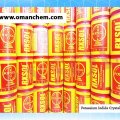
Product code RXSOL-95-8122-025Category Medicine

Price and availability on request. Send us the quantity and delivery location in Oman.

Overview

Range of Avg. Molecular Weight 5400-6600

Product description

PEGs are soluble in water and most organic solvents. The reason for for using PEGs with large molecular weight is that smaller PEGs can diffuse through the cell wall and are even taken up by plant cells and distributed through the plant, which may influence the results. larger than 6,000 (PEG 6000) are inert, non-ionic and cell impermeable. to simulate osmotic stress.

Applications

Polyethylene glycols are non-toxic, odorless, neutral, lubricating, nonvolatile and nonirritating and are used in a variety of pharmaceuticals and in medications as a solvent, dispersing agent, ointment and suppository bases, vehicle, and tablet excipient.

Industries and related products

Melting Point:
PEG 300 = -11°C
PEG 400 = 4-8 °C
PEG 600 = 20-25 °C
PEG 1500 = 44-48 °C
PEG 4000 = 54-58 °C
PEG 6000 = 56-63°C

Dosage

Polyethylene glycol, referred to as PEG, is used as an inactive ingredient in the pharmaceutical industry as a solvent, plasticizer, surfactant, ointments and suppository base, and tablet and capsule lubricant. ... PEG is also available as a bowel prep for colonoscopy procedures and as a laxative

Also known as

PEG 6000, Polyethylene Glycol 6000 - 25 kg BAG

Notes

Polyethylene glycols (PEGs) are condensation polymers of ethylene oxide and water with the general formula H(OCH2CH2)nOH. They are the most commercially important type of polyether. The low molecular weight compounds up to 700 are colorless, odorless viscous liquids with a freezing point from -10˚C (diethylene gycol), while polymerized compounds with higher molecular weight than 1,000 are wax like solids with melting point up to 67˚C. While PEGs with different molecular weights find use in different applications and have different physical properties (e.g. viscosity) due to chain length effects, their chemical properties are nearly identical.
 
The numbers that are often included in the names of PEGs indicate their average molecular weights, e.g. a PEG with n=9 would have an average molecular weight of approximately 400 and would be labeled PEG 400. Most PEGs include molecules with a distribution of molecular weights, i.e. they are polydisperse.

Remarks

The addition of PEG to a protein solution increases the chemical potential of the protein. Precipitation of the protein occurs when its chemical potential exceeds the level of a saturated solution.

Where we supply

Oman. Stocked at our warehouse in Barka, South Al Batinah, and supplied to Muscat, Ruwi, Mutrah, Seeb, Rusayl, Barka, Sohar, Shinas, Saham, Buraimi, Nizwa, Ibri, Sur, Salalah, Duqm, Khasab and every other governorate.

Ports and free zones. Port Sultan Qaboos (Mutrah), Mina Al Fahal, Sohar Port and Freezone, Port of Salalah and Salalah Free Zone, Port of Duqm and the Duqm Special Economic Zone, Port of Sur, Khasab Port and Al Mazunah Free Zone.

Industrial areas. Rusayl, Sohar, Barka (Sanaya), Raysut (Salalah), Nizwa, Sur, Buraimi and Duqm industrial estates, Knowledge Oasis Muscat, and oil and gas sites across Oman.

Beyond Oman. We have branches in the UAE (including Fujairah) and in India (Kandla, Kolkata, Visakhapatnam, Chennai and Mumbai), and we also supply to South Africa.