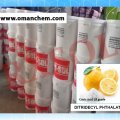
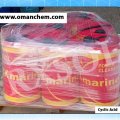
Price and availability on request. Send us the quantity and delivery location in Oman.
Product description
Overview. Pure 100% Citric acid is widely used as organic acid in food stuff.
Applications
Citric acid monohydrate is used in the preparation of citrate buffer in platelets for intravital microscopy. It acts as a pH-control agent in foods, beverages and pharmaceuticals applications. It acts as an iron chelator. In animals, it improves the utilization of nutritional calcium. It is a useful buffer component for antigen and epitope unmasking. It is also used as an acidifier, a flavoring agent and a chelating agent. For cosmetics and personal care products. For pharmaceutical preparations, especially effervescent tablets.
Where it is used
| ITEM | Unit | Quality Standards | Analysis Results |
| Characters |
-------------
crystalline powder, colourless
crystals or granules. Odorless,
has a strongly acid taste. Very
soluble in water, freely soluble
in ethanol.White or almost white,
crystalline powder, colourless
crystals or granules. Odorless,
has a strongly acid taste. Very
soluble in water, freely soluble
in ethanol.
|
White or almost white,
crystalline powder, colourless
crystals or granules. Odorless, has a strongly acid taste. Very soluble in water, freely soluble
in ethanol.White or almost white,
crystalline powder, colourless
crystals or granules. Odorless,
has a strongly acid taste. Very
soluble in water, freely soluble
in ethanol.White or almost white,
crystalline powder, colourless
crystals or granules. Odorless,
has a strongly acid taste. Very
soluble in water, freely soluble
in ethanol.
|
Pass |
| Identification | ---- | Pass Test | Pass |
| Appearance of solution |
---- |
Pass Test | Pass |
| Assay | % | 99.5~100.5 | 99.9 |
| Water | % | ≤0.5 | 0.1 |
|
Readily Carbonisable Substances
(Residue on Ignition)Sulphated Ash 硫酸灰分
(Residue on Ignition)
|
---- | Pass Test | Pass |
| Sulphated Ash (Residue on Ignition) | % | ≤0.05 | 0.02 |
| Sulfate | mg/kg | ≤150 | 150 |
| Oxalate | mg/kg | ≤100 | 100 |
| Lead | mg/kg | ≤0.5 | 0.5 |
| Arsenic | mg/kg | ≤1 | 1 |
| Mercury | mg/kg | ≤1 | 1 |
| Aluminum | mg/kg | ≤0.2 | 0.2 |
|
Heavy Metals (as Pb)
Heavy Metals (as Pb)
重金属(以 Pb 计)
|
mg/kg | ≤0.2 | 0.2 |
| Bacterial endotoxins | IU/mg | 0.5 | 0.5 |
| Conclusion: | The product is in conformity with STANDARD. |
Dosage
Citric Acid is Natural preservative and a commonly used ingredient
Citric acid is used in many sour dishes and to impart a tart flavor in baking dishes
Citric Acid also used as Antioxidant
Citric Acid is the most versatile and widely used organic acid in food stuff. It is used as preservative, emulsifying agent and as an anti oxidant. Present in lemons and many other ripe fruits.
Also known as
Citric Acid Food Grade
Notes
Solubility : Citric Acid Monohydrate is very soluble in water, freely soluble in ethanol and sparingly soluble in ether.
Stability and storage : Citric Acid Monohydrate may be stored for 48 months from the date of manufacture in the unopened original container. A relative humidity of 50% and a temperature range of 10–30 °C are the most suitable conditions for storage. Temperatures above 40 °C and a relative humidity above 70% should be avoided in order to prevent caking, especially the Fine Granular form. The stacking of the Fine Granular form for long periods is not recommended. Stability tests have shown that Citric Acid Monohydrate is chemically stable for at least five years in tightly closed containers under proper storage conditions.
Hazard Statements : Causes skin irritation. Causes serious eye irritation. May cause respiratory irritation.
Precautionary Statements : Avoid breathing dust/fume/gas/mist/vapours/spray. Wear protective gloves and eye/face protection. IF IN EYES: Rinse cautiously with water for several minutes. Remove contact lenses, if present and easy to do. Continue rinsing. IF INHALED: Remove to fresh air and keep at rest in a position comfortable for breathing. Store locked up. Dispose of contents/container in accordance with local/regional/national/international regulations.
Where we supply
Oman. Stocked at our warehouse in Barka, South Al Batinah, and supplied to Muscat, Ruwi, Mutrah, Seeb, Rusayl, Barka, Sohar, Shinas, Saham, Buraimi, Nizwa, Ibri, Sur, Salalah, Duqm, Khasab and every other governorate.
Ports and free zones. Port Sultan Qaboos (Mutrah), Mina Al Fahal, Sohar Port and Freezone, Port of Salalah and Salalah Free Zone, Port of Duqm and the Duqm Special Economic Zone, Port of Sur, Khasab Port and Al Mazunah Free Zone.
Industrial areas. Rusayl, Sohar, Barka (Sanaya), Raysut (Salalah), Nizwa, Sur, Buraimi and Duqm industrial estates, Knowledge Oasis Muscat, and oil and gas sites across Oman.
Beyond Oman. We have branches in the UAE (including Fujairah) and in India (Kandla, Kolkata, Visakhapatnam, Chennai and Mumbai), and we also supply to South Africa.