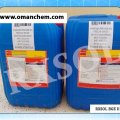
Product code RXSOL-32-3101-050Category Water Filter, Vessel, Softner, Accessory

Price and availability on request. Send us the quantity and delivery location in Oman.

Overview

Mixed Bed Resins are used to get high purity Water

Product description

Mixed Bed resins, a mixture of cation and anions are used as polishers to obtain low conductivity water. Typically, low conductivity water is required for bolier feed for high pressure boilers, electronics, electrical discharge cutting machines and pharmaceutical applications.

Mixed Bed can also be used as a primary deionisation unit when the inlet salt is low. Mixed Beds also find applications in process industry where demineralization of pH sensitive products is to be carried out.

Mixed Bed Resins can be supplied in highly regenerated, premixed conditions for use in dye applications or they are also available as highly regenerated cations and anions for use in regeneratable mixed bed units. Premixed Resin is available in different proportions and combinations of cations and anions to suit the end of users needs.

NOTE: Mixed Beds are generally used in applications where water of very low conductivity is desired.

Applications

The Poular application is as below -

  • Ultra pure water production
  • Demineralisation
  • Deionisation 
  • Condensate polishing (boiler feed water)
  • Micro-electronics cleaning
  • Pharmaceuticals
  • Metal Removal

Industries and related products

Rinse Cycle:

The rinse cycle removes remaining brine from the tank. Normally 10 minutes of Rinse flow equivalent to service flow is sufficient to rinse out excess brine.

Though synthetic softening resins normally last 5 years or so, but certain conditions can cause resin to breakdown earlier. Oxidation by chlorine is probably the most common cause of resin breakdown. When chlorine is used to oxidize iron in the water, the chlorine should be removed before ion exchange.

Secondly Iron will significantly affect the ability of resins to remove hardness ions. Ferrous iron can be oxidized during softening and precipitate out as iron oxide on the resin, and no amount of brine will remove the iron fouling. If iron oxide is formed before ion exchange unit, it can be filtered out by the resin and removed during the backwashing of the unit. Normally if the iron concentration in the source water is high, iron removal is provided ahead of the exchange unit to prevent fouling of the unit.

Turbidity, organic chemicals, and bacterial slimes resins resulting in the loss of some of the resin exchange capacity. The best solution is to remove of the suspended matter with filtration before the softening process.

ADVANTAGES OF ION-EXCHANGE SOFTENING:

Compared with lime-soda ash softening, ion-exchange has certain advantages. It is compact and has a low capital cost. The chemicals used are safer for the operator to handle and operation is much easier. It can be totally automated. Softeners also can be Automatic duplex type to ensure continuous supply of soft water in case of critical application like Boiler Feed etc. Many systems have found ion-exchange to be the most cost effective way to produce quality water for their customers.

Dosage

Each application requires a different water quality. In general cation resin for water softening and demineralization may last 5 to 10 years. Anion resins used in demineralization last anywhere from 3 to 5 years and are dependent on operational conditions. Like every other resin, the life of mixed bed resin is dependent on the application in which it is being used. Resin life is difficult to predict; in critical applications it's best to start analyzing and benchmarking the resin at least once per year.

Also known as

Tulsion Mixed Bed, Amberlite, DI WATER RESIN, Softener Unit Resin, ION EXCHANGE RESIN, Thermax Mixed Bed Resin 50 Ltr Pack

Where we supply

Oman. Stocked at our warehouse in Barka, South Al Batinah, and supplied to Muscat, Ruwi, Mutrah, Seeb, Rusayl, Barka, Sohar, Shinas, Saham, Buraimi, Nizwa, Ibri, Sur, Salalah, Duqm, Khasab and every other governorate.

Ports and free zones. Port Sultan Qaboos (Mutrah), Mina Al Fahal, Sohar Port and Freezone, Port of Salalah and Salalah Free Zone, Port of Duqm and the Duqm Special Economic Zone, Port of Sur, Khasab Port and Al Mazunah Free Zone.

Industrial areas. Rusayl, Sohar, Barka (Sanaya), Raysut (Salalah), Nizwa, Sur, Buraimi and Duqm industrial estates, Knowledge Oasis Muscat, and oil and gas sites across Oman.

Beyond Oman. We have branches in the UAE (including Fujairah) and in India (Kandla, Kolkata, Visakhapatnam, Chennai and Mumbai), and we also supply to South Africa.